
Osceola County Court Records After Arrest
An Osceola County arrest may begin with transport to the jail, but the court record is built after prosecutorial and court action. The Osceola County Prosecuting Attorney, Anthony Badovinac, is identified by the county as the chief law enforcement officer with criminal jurisdiction for state-statute felonies and misdemeanors in the county. That office reviews the matter and decides what charges to file in court.
Booking allegations and court charges can differ. A booking entry may reflect what an officer alleged at intake, while court records show the complaint, amended charges, bond orders, hearings, bindover events, pleas, verdicts, dismissal, sentence, or warrant events. Current custody and booking information belongs with jail inmate records, while booking photos are handled through the jail mugshot and FOIA path.
Custody and court are separate: A person can have a court case without still being in jail, and a new jail booking may not appear in court search until charges are filed.
Find Osceola Court Records After Arrest
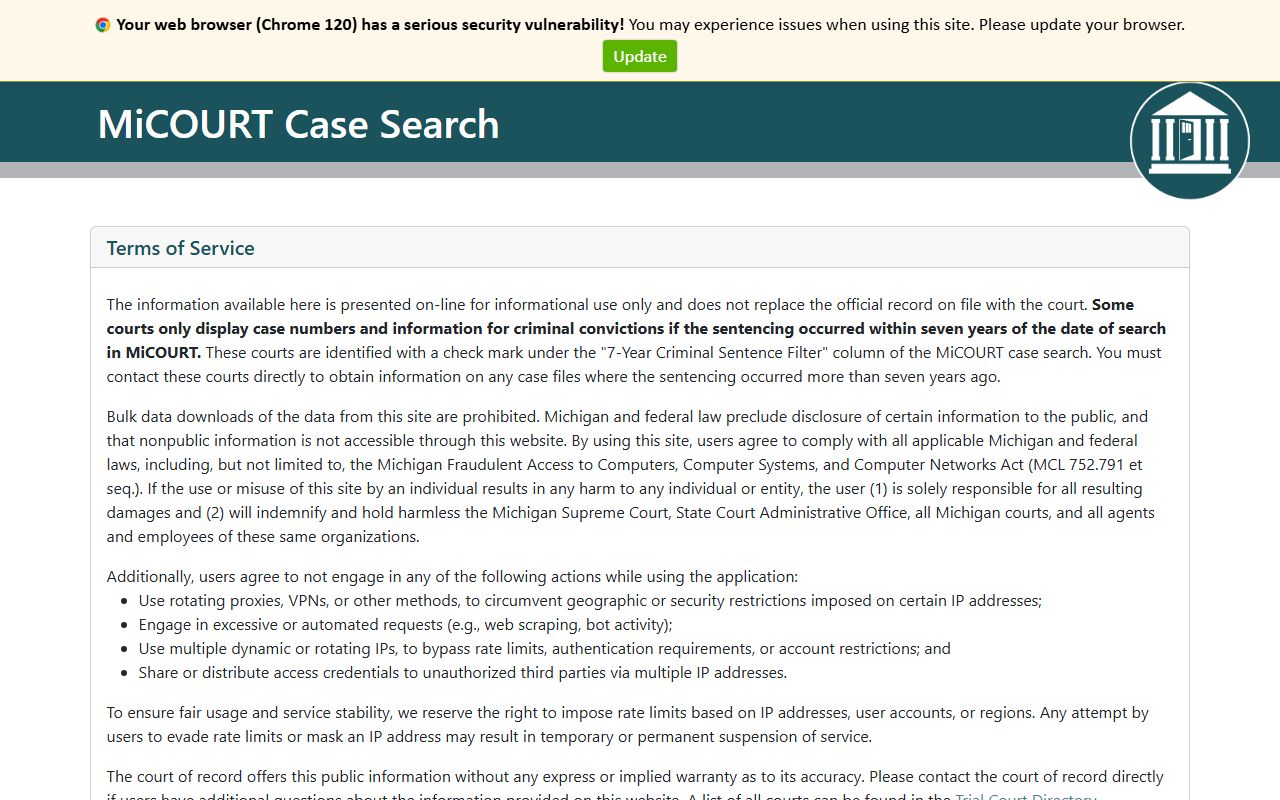
The main public court-search channel is MiCOURT Case Search, a statewide Michigan court case search portal. For Osceola County court records after a jail arrest, search by defendant name, case number if known, and the court or county options available in the portal. The portal is best used after formal charges exist. If the arrest is too recent, start with the sheriff phone transfer and then return to the court search after arraignment or filing.
- Confirm the person's full name, likely spelling, and approximate arrest or booking date.
- Search MiCOURT by party or case number, narrowing to the relevant court when the portal allows it.
- Review the case type, filed charges, hearing dates, bond entries, and status terms.
- For a misdemeanor or early felony matter, contact 77th District Court if the public portal does not answer the question.
- For a felony case after bindover, use the 49th Circuit Court or County Clerk records path.
The manifest screenshot for the Michigan court case search portal shows the state-level search starting point, not a jail roster. That distinction matters for court records after a jail arrest because the case search tracks filed court activity rather than real-time jail housing.
77th District Court Records
The 77th District Court sits at 301 W. Upton in Reed City. The county page lists Judge Peter Jaklevic, Magistrate Thea Titus, and criminal clerk Tiffany Raymond at (231) 832-6155 option 1. District Court handles misdemeanors punishable by not more than one year, arraignments, setting and acceptance of bail, trial, sentencing, and preliminary examinations in felony cases.
For court records after an arrest, District Court is often the first local court stop. A recent arrest may lead to arraignment, bond review, conditions of release, appointment or appearance of counsel, and scheduling. Felony cases commonly begin in District Court for preliminary proceedings, then may bind over to Circuit Court if the case moves forward. Magistrates may set bail, accept bond, and issue arrest or search warrants authorized by the prosecutor or municipal attorney.
49th Circuit Court Records
The 49th Circuit Court serves Osceola and Mecosta counties. The Osceola page lists the court at 301 W. Upton, Reed City, with phone (231) 832-3261 ext. 2 and fax (231) 832-6149. It identifies felony and higher-level case work, including criminal and civil record searches. For felony court records after a jail arrest, Circuit Court becomes important after bindover, waiver, or other transfer from District Court.
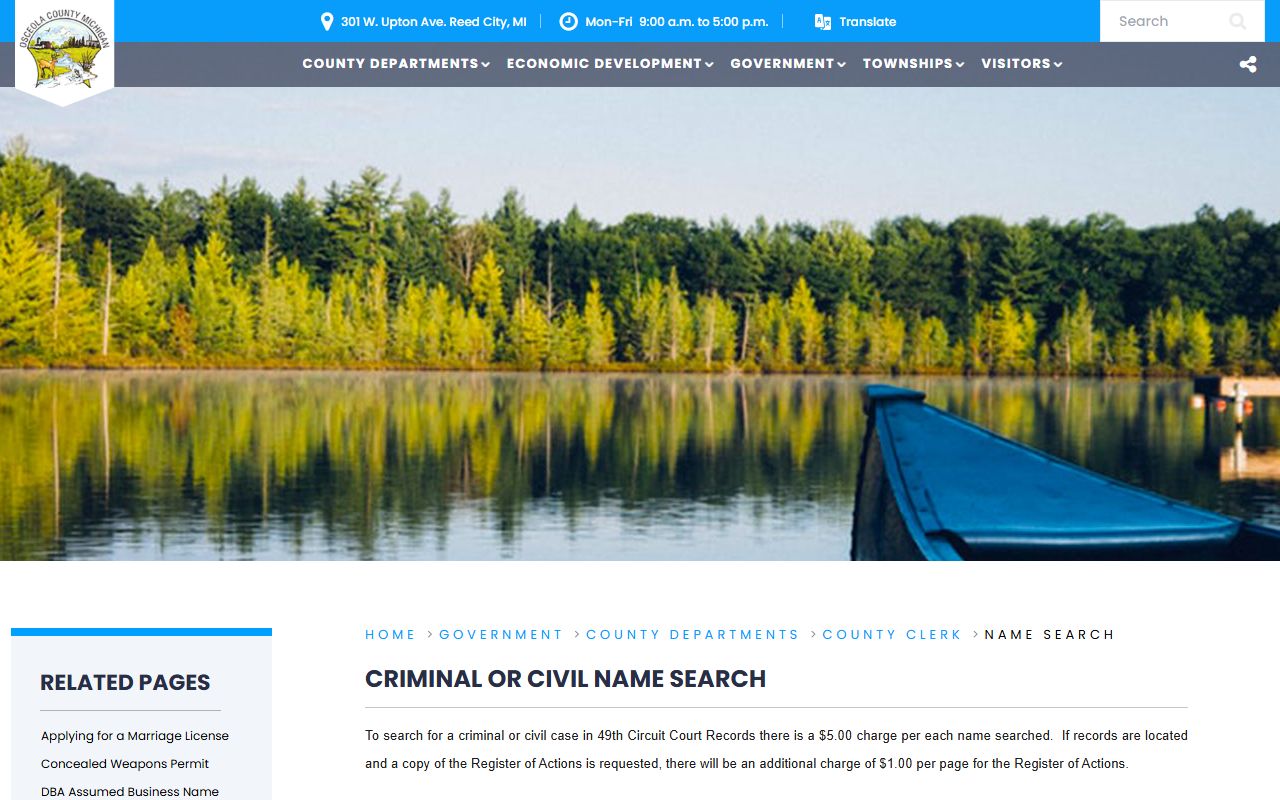
The County Clerk name-search page gives a paid backup route for 49th Circuit Court records. It states that a criminal or civil name search costs $5 per name. If records are found and a Register of Actions copy is requested, the page lists an additional $1 per page. A Register of Actions is the court docket summary that shows filings, hearings, and case events.
The county clerk name-search screenshot in the manifest is useful where MiCOURT is not enough. It shows that some Osceola County court records after an arrest may require clerk handling and a fee rather than a no-cost web search.
Charging Records After Arrest
Court records after an Osceola County jail arrest usually begin with a complaint or another charging document. Michigan felony cases may later use an information after bindover or waiver. The research did not identify local grand-jury practice details for Osceola County, so indictment should be described as a possible charging document in general criminal procedure, not as the usual local route.
| Document | Who files or authorizes it | What it does |
|---|---|---|
| Complaint | Prosecutor or authorized charging process | Starts or supports the criminal case after arrest and states the alleged offense. |
| Information | Prosecutor | Common felony charging document after bindover or waiver into Circuit Court. |
| Indictment | Grand jury process where used | A formal accusation in cases where that process applies. |
Osceola Charge Status Records
A charge in court records after an arrest is not a conviction. It is an accusation pending court action. Charges may be amended, reduced, dismissed, bound over, disposed, sentenced, or linked to a bench warrant or probation violation. That is why a jail booking charge should not be treated as the final case result. The court record shows what the prosecutor filed and what the judge later ordered.
| Status | What it means |
|---|---|
| Pending | The charge remains active and no final disposition appears yet. |
| Amended | The filed charge changed from an earlier version. |
| Reduced | The charge moved to a lower offense level or different offense. |
| Dismissed | The court record shows the charge was dropped or ended without conviction. |
| Bound over | A felony moved from District Court to Circuit Court after preliminary proceedings. |
| Sentenced | A conviction or plea led to a judgment and sentence entry. |
Bond Records After Arrest
Bond and release terms often appear early in court records after a jail arrest. The 77th District Court page states that District Court handles setting and acceptance of bail, and that magistrates may set bail and accept bond in criminal matters. The sheriff page links eXpress Account for bond and bill payments, but the court remains the authority for the bond amount, bond type, and conditions.
| Bond term | Plain meaning |
|---|---|
| Cash bond | Money paid as directed by the court or jail after confirming the amount and payee. |
| Surety bond | A licensed bond agent or insurer posts the bond, subject to court rules. |
| Personal recognizance | Release based on a written promise and conditions rather than full cash payment. |
| No-bond hold | Release is blocked by a warrant, detainer, probation/parole hold, federal issue, ICE issue, or court order. |
Paying local bond may not cause release if another agency has a hold. Verify custody through the jail and verify bond terms through the court before using a payment vendor.
Warrants and Court Records
No official Osceola County sheriff active-warrant search was located. The District Court page still gives an official route for understanding warrants because it says magistrates may issue arrest and search warrants authorized by the prosecutor or municipal attorney. MiCOURT may show warrant-related docket events in a public case, but it should not be assumed to display every warrant.
MSP ICHAT is not a warrant search. The Michigan State Police criminal-history page says ICHAT excludes warrant information, federal records, tribal records, traffic records, juvenile records, many local misdemeanors, and out-of-state histories. For a warrant tied to an Osceola County court case, contact the court of jurisdiction and consider legal counsel before making appearance or surrender decisions.
Charges vs Convictions
Osceola County court records after an arrest can show both unresolved charges and final convictions. These are not the same. A charge is the accusation filed in court. A conviction requires a plea, verdict, or judgment. Public case records must be read with that difference in mind, especially before using any information for decisions that require formal legal review.
| Point | Charge | Conviction |
|---|---|---|
| Stage | Filed accusation after arrest. | Final judgment after plea or verdict. |
| Status | May be pending, amended, reduced, or dismissed. | May lead to sentence, probation, jail, prison, or other orders. |
| Meaning | Not proof of guilt. | Court finding or admitted guilt. |
Sealed and Expunged Records
Michigan set-aside law affects qualifying convictions after court disposition, not the moment of booking. The research cites MCL 780.621 for Michigan set-aside and Clean Slate context. A dismissed case, set-aside conviction, juvenile matter, sealed record, or confidential case may not appear like an ordinary public court record.
| Record type | Public effect | Where to verify |
|---|---|---|
| Sealed or confidential | Hidden from ordinary public access under court rule or statute. | Court clerk or legal counsel. |
| Set aside / expunged | Qualifying conviction is set aside under Michigan law. | Michigan court order and MSP Clean Slate resources. |
| Dismissed | Charge ended without conviction, but related records may have separate handling rules. | Court docket, clerk, and records custodian. |
Criminal History Limits
Michigan State Police ICHAT is useful for public criminal-history checks, but it is not a live custody search and not a complete court file. MSP says ICHAT includes public criminal history maintained by MSP for felonies and serious misdemeanors punishable by more than 93 days when reported by agencies, prosecutors, and courts. It excludes warrants, federal, tribal, traffic, juvenile, local misdemeanor, and out-of-state history.
Important: Do not use informal court, jail, or search-box results for FCRA-regulated employment, credit, tenant, insurance, or similar screening.
Restricted Court Records After Arrest
Some Osceola County court records after arrest may be limited or unavailable to the public. Juvenile matters, sealed cases, confidential filings, active-investigation material, protected victim information, and FOIA-exempt content may be withheld or redacted. Booking photos also have a separate Michigan statute, MCL 764.26a, that controls release and agency website removal in listed circumstances.
When the court record is missing from the public portal, use the right office rather than a third-party site. Start with MiCOURT, then District Court, Circuit Court, or the County Clerk depending on case stage. For custody, use the sheriff phone path. For booking records or jail-held documents not online, use Osceola County FOIA.
Public Record Search
Sponsored Results